

Tag: Illinois Insurance

  • No One Expects to Become Uninsurable — But It Happens Every Day

    No One Expects to Become Uninsurable — But It Happens Every Day

    Ask anyone who has been declined for life insurance whether they saw it coming. Almost universally, the answer is no.

    Nobody wakes up one day and thinks “today is the day I become uninsurable.” It doesn’t work like that. It happens gradually — a diagnosis here, a prescription there — until the day you finally decide to apply for coverage and discover that the window has closed.

    What Does “Uninsurable” Mean?

    When an insurance company evaluates your application, they assess your health risk through a process called underwriting. They look at your medical history, current health conditions, medications, family history, height and weight, and other factors.

    If the risk of insuring you is deemed too high, the company may decline your application entirely. Or they may offer coverage at a significantly higher premium — sometimes two, three, or even four times the standard rate.

    Common conditions that can affect your insurability include:

    • Type 2 diabetes
    • Heart disease or prior heart attack
    • Cancer (current or recent history)
    • Stroke
    • Sleep apnea
    • Obesity
    • Certain mental health conditions
    • Tobacco use

    None of these are rare. Millions of Americans are living with one or more of these conditions right now — many of them wishing they had applied for life insurance before the diagnosis.

    The Cruelest Irony of Life Insurance

    Here’s what makes this so painful: the people who need life insurance most urgently — those with health conditions, those getting older, those with dependents counting on them — are often the hardest to insure.

    The system rewards those who act early. The people who buy coverage in their 20s and 30s, while they’re young and healthy, lock in low rates and guaranteed protection. Those who wait discover that the cost has gone up — or the door has closed.

    Living Benefits: A Silver Lining Worth Knowing About

    Here’s something most people don’t know: many modern life insurance policies include living benefits riders that allow you to access your death benefit early if you’re diagnosed with a critical, chronic, or terminal illness. If you become seriously ill, this coverage can help pay for care, replace lost income, or cover medical expenses.

    But here’s the catch: you have to qualify for and own the policy before the diagnosis. Once you’re sick, it’s too late.

    You’re Healthy Today. Don’t Gamble With Tomorrow.

    I’m not saying this to scare you. I’m saying it because I’ve spent 20 years inside the financial services industry watching people delay this decision — and seeing the consequences firsthand.

    The best time to apply for life insurance was yesterday. The second best time is today.

    At Next Chapter Insurance Agency LLC, I make the process simple, clear, and pressure-free. Let’s get you covered while the getting is good.


    Doreen Patrick is an IL-licensed Life & Health Insurance Agent with Next Chapter Insurance Agency LLC, an independent agent with Equis Financial. Licensed in Illinois.

  • The Younger You Are, the Less You Pay: Why Age Is the Biggest Factor in Life Insurance Premiums

    The Younger You Are, the Less You Pay: Why Age Is the Biggest Factor in Life Insurance Premiums

    Here’s a fact that surprises almost every young person who looks into life insurance for the first time: you will never be offered a lower premium than you are right now.

    Life insurance pricing is based primarily on two factors — your age and your health. And both of those things only move in one direction.

    How Age Affects Your Premium

    Insurance companies calculate premiums based on statistical risk. The older you are, the higher the statistical probability that a claim will be made during the policy term. That increased risk is reflected in higher premiums.

    The difference is more significant than most people expect. A healthy 30-year-old might pay $25–$30 per month for a 20-year term policy with $500,000 in coverage. That same policy for a healthy 45-year-old might cost $75–$100 per month. Wait until 55 and you could be looking at $200 or more per month — for the same coverage.

    Locking In Your Rate

    Here’s the good news about term life insurance: once you’re approved, your premium is locked in for the entire term. It doesn’t increase as you age. It doesn’t go up if your health changes.

    That 30-year-old paying $28 a month today will still be paying $28 a month at age 50 — even if they develop a health condition that would make them uninsurable if they applied at that age.

    Health Matters Just as Much as Age

    Age is only half the equation. Your health at the time of application also plays a major role in determining your premium. Conditions like high blood pressure, diabetes, obesity, and tobacco use can significantly increase your rate — or result in a declined application.

    Right now, today, is likely the healthiest you’ll be for the rest of your life. That’s not pessimism — that’s just reality. And locking in your coverage while you’re healthy is one of the smartest financial decisions you can make for your family.

    The Real Cost of Waiting

    Let’s say you’re 32 today and you keep putting it off. By the time you get around to it at 38, your premium for the same coverage could be 40–60% higher. Over a 20-year term, that difference in premium could add up to thousands of dollars.

    Waiting doesn’t save you money. It costs you money.

    Start Today

    At Next Chapter Insurance Agency LLC, I work with 20+ top-rated carriers to find the best rate for your specific age and health profile. The application process is simpler than you think — and getting a quote is completely free.


    Doreen Patrick is an IL-licensed Life & Health Insurance Agent with Next Chapter Insurance Agency LLC, an independent agent with Equis Financial. Licensed in Illinois.

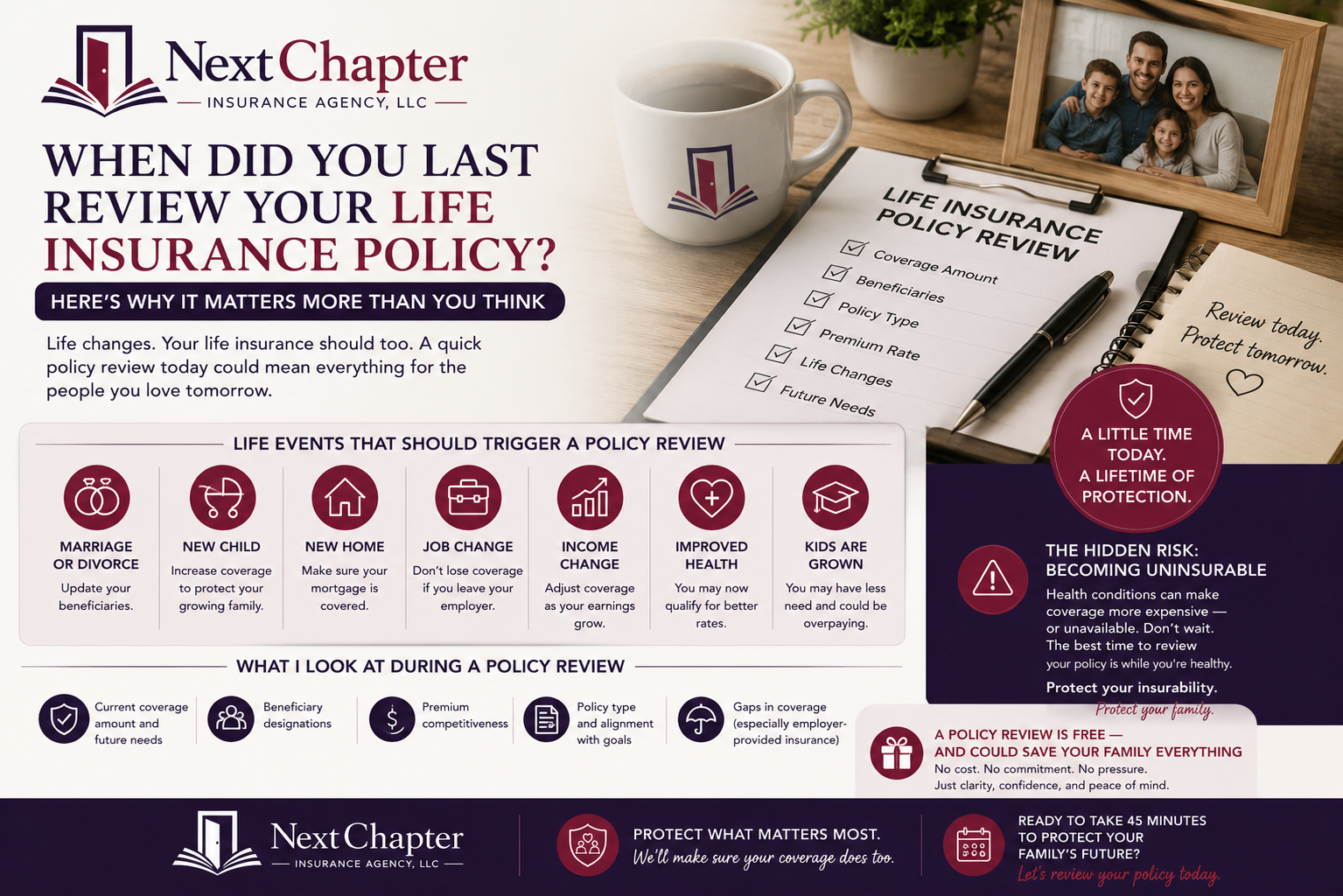
  • When Did You Last Review Your Life Insurance Policy? Here’s Why It Matters More Than You Think

    When Did You Last Review Your Life Insurance Policy? Here’s Why It Matters More Than You Think

    You bought life insurance. You filed the paperwork. You set up the automatic payments.

    And then — if you’re like most people — you haven’t thought about it since.

    Here’s the thing: life insurance isn’t a “set it and forget it” product. Life changes, and your coverage should change with it. A policy that perfectly fit your life five years ago might leave your family significantly underprotected today.

    What Is a Policy Review?

    A policy review is simply a check-in on your existing life insurance coverage. It looks at what you currently have, compares it to where you are in life today, and identifies any gaps — or opportunities to improve your coverage or lower your premiums.

    It costs nothing and takes less than an hour. But it can make a significant difference.

    Life Events That Should Trigger a Policy Review

    If any of the following have happened since you last looked at your coverage, it’s time for a review:

    • You got married or divorced — your beneficiary designations need to be updated
    • You had a child — your coverage amount may need to increase significantly
    • You bought a home — your mortgage should be factored into your coverage needs
    • You changed jobs — especially if you lost employer-provided life insurance
    • Your income increased — your coverage may no longer be proportionate to your earnings
    • Your health improved — you may now qualify for better rates than when you first applied
    • Your children are now adults — your coverage needs may have decreased, and you may be overpaying

    The Hidden Risk: Becoming Uninsurable

    Here’s something most people don’t consider until it’s too late. Qualifying for life insurance depends heavily on your health at the time you apply. Conditions like diabetes, heart disease, cancer, and even sleep apnea can make coverage significantly more expensive — or result in a denial.

    If you’ve been putting off reviewing or increasing your coverage, every year that passes is a year where your health could change. No one expects to become uninsurable. But it happens every single day.

    The best time to review and lock in your coverage is while you’re healthy.

    What I Look at During a Policy Review

    When we sit down for a policy review, I’ll look at:

    • Your current coverage amount and whether it still meets your needs
    • Your beneficiary designations
    • Whether your premium is competitive given current market rates
    • Whether your policy type still aligns with your goals
    • Any gaps in coverage — especially if you rely on employer-provided insurance

    A Policy Review Is Free — and Could Save Your Family Everything

    There’s no cost, no commitment, and no pressure. Just a clear picture of where you stand and what, if anything, needs to change.

    Ready to take 45 minutes to protect your family’s future?


    Doreen Patrick is an IL-licensed Life & Health Insurance Agent with Next Chapter Insurance Agency LLC, an independent agent with Equis Financial. Licensed in Illinois.

  • What Is an Annuity — And Could It Be the Missing Piece in Your Retirement Plan?

    What Is an Annuity — And Could It Be the Missing Piece in Your Retirement Plan?

    One of the biggest fears people have about retirement isn’t dying too soon — it’s living too long. Running out of money before you run out of years is a very real concern, and it’s one that annuities are specifically designed to address.

    But what exactly is an annuity? And do you need one?

    What Is an Annuity?

    An annuity is a contract between you and an insurance company. You contribute a lump sum or series of payments, and in return, the insurance company provides you with a guaranteed stream of income — either immediately or at a future date.

    Think of it as a personal pension. You’re essentially buying yourself a paycheck that you cannot outlive.

    Types of Annuities (The Ones I Can Help You With)

    As an insurance-licensed agent, I work with:

    • Fixed Annuities — your money grows at a guaranteed interest rate. Safe, predictable, no market risk.
    • Fixed Indexed Annuities (FIA) — your growth is linked to a market index like the S&P 500, but your principal is protected. You can benefit from market gains without risking your savings when the market drops.
    • Multi-Year Guaranteed Annuities (MYGA) — similar to a bank CD but typically with higher interest rates and tax-deferred growth.

    Why Would a Young Family Consider an Annuity?

    Annuities aren’t just for retirees. If you’re in your 30s or 40s, putting money into a fixed indexed annuity now means decades of tax-deferred growth — and a guaranteed income stream waiting for you in retirement. The earlier you start, the more powerful the compounding effect.

    What Annuities Are NOT

    It’s important to clarify: annuities are insurance products, not investments. I am not a financial advisor or investment planner. Annuities work alongside your 401(k), IRA, and other retirement accounts — they are not a replacement for them.

    Is an Annuity Right for You?

    If you’re concerned about outliving your money, want guaranteed income in retirement, or are looking for a safe place to grow savings with tax advantages, an annuity conversation is worth having.

    At Next Chapter Insurance Agency LLC, I’ll explain your options in plain English — no pressure, no jargon.


    Doreen Patrick is an IL-licensed Life & Health Insurance Agent with Next Chapter Insurance Agency LLC, an independent agent with Equis Financial. Annuities are insurance products. I am not a registered investment advisor or financial planner. Licensed in Illinois.

  • What Is Whole Life Insurance — And Why Do Some People Swear By It?

    What Is Whole Life Insurance — And Why Do Some People Swear By It?

    If you’ve ever looked into life insurance for more than five minutes, you’ve probably encountered two camps: people who say “just get term” and people who swear whole life insurance is the smarter long-term play.

    So who’s right? The honest answer is — it depends on your goals. Here’s what you need to know.

    What Is Whole Life Insurance?

    Unlike term life insurance, which covers you for a set period of time, whole life insurance covers you for your entire life — as long as you keep paying the premiums. It never expires. It never needs to be renewed.

    But that’s not the only difference. Whole life insurance also builds cash value over time. A portion of every premium you pay goes into a savings-like account that grows at a guaranteed rate, tax-deferred. Over the years, that cash value becomes an asset you can borrow against or, in some cases, withdraw from.

    What Are the Benefits of Whole Life?

    • Lifetime coverage — your beneficiaries are guaranteed a death benefit no matter when you pass away
    • Level premiums — your payment never increases, even as you age
    • Cash value growth — builds over time and can be used for emergencies, retirement supplementation, or other needs
    • Predictability — guaranteed death benefit, guaranteed premium, guaranteed cash value growth rate

    Who Is Whole Life Best For?

    Whole life isn’t the right fit for everyone, but it’s an excellent option for people who:

    • Want lifelong coverage regardless of health changes later in life
    • Are interested in building tax-deferred cash value over decades
    • Have a permanent need — like covering final expenses or leaving a legacy for their family
    • Are business owners looking at buy-sell agreements or key person insurance

    Whole Life vs. Term Life — The Key Difference

    Think of it this way. Term life is like renting an apartment — it serves a need for a period of time and is usually more affordable month to month. Whole life is more like owning a home — the monthly cost is higher, but you’re building equity and you own it permanently.

    Neither is universally better. It comes down to your goals, your budget, and your timeline.

    Want to Know Which One Makes Sense for You?

    At Next Chapter Insurance Agency LLC, I take the time to understand your situation before recommending anything. Let’s find the coverage that actually fits your life.


    Doreen Patrick is an IL-licensed Life & Health Insurance Agent with Next Chapter Insurance Agency LLC, an independent agent with Equis Financial. Licensed in Illinois.

  • What Is Term Life Insurance — And Is It Right for Your Family?

    What Is Term Life Insurance — And Is It Right for Your Family?

    You’ve probably heard the term “life insurance” more times than you can count — but when someone asks you to explain exactly what term life insurance is, do you know the answer?

    You’re not alone. Most people know they probably need life insurance, but the details feel overwhelming. Let’s break it down simply.

    What Is Term Life Insurance?

    Term life insurance is exactly what it sounds like — life insurance that covers you for a specific term, or period of time. Common terms are 10, 20, or 30 years. If you pass away during that term, your beneficiaries receive a tax-free death benefit. If the term ends and you’re still living, the policy expires.

    That’s it. No complicated investment components. No cash value. Just straightforward protection for the people who depend on you.

    Why Do People Choose Term Life?

    The biggest reason: it’s affordable. Because term life is pure protection with no investment element, the premiums are typically much lower than other types of life insurance. A healthy 30-year-old can often get $500,000 of coverage for less than the cost of a daily cup of coffee.

    Term life is especially popular with:

    * Young families with a mortgage

    * Parents with young children

    * Families with one primary income earner

    * Anyone with significant debt they don’t want to leave behind

    How Much Coverage Do You Need?

    A common rule of thumb is 10–12 times your annual income. So if you earn $60,000 a year, you’d look at $600,000–$720,000 in coverage. But everyone’s situation is different — your mortgage balance, number of children, spouse’s income, and debt all factor in.

    The One Thing Most People Don’t Know About Term Life

    Your work life insurance is likely a term policy — but here’s the catch: it’s tied to your job. If you leave, get laid off, or your employer changes benefits, that coverage disappears. A personally owned term policy goes with you no matter where you work.

    Ready to See What Term Life Would Cost You?

    At Next Chapter Insurance Agency LLC, I shop 20+ top-rated carriers to find the best rate for your specific situation. There’s no pressure and no obligation — just clear, honest answers.

    Contact Doreen Patrick today for a free quote. Doreen Patrick is an IL-licensed Life & Health Insurance Agent with Next Chapter Insurance Agency LLC, an independent agent with Equis Financial. Licensed in Illinois.